Building a Nordic Identity with Type
Creating a clean brand identity requires balancing strict functionality with subtle warmth. When developing serif sans serif typography pairings for Scandinavian minimalist brand guide projects, the goal is to let the content breathe. You achieve this by matching a highly legible geometric sans serif with a refined, low-contrast serif.
Why Nordic Design Demands Contrast
Scandinavian design relies heavily on negative space and natural light. Your typography must reflect this quiet environment. A sans serif handles structural elements like navigation and captions, while the serif introduces a human touch for long-form reading or elegant headlines.
This deliberate contrast prevents the minimalism from feeling cold or sterile. Readers process minimalist layouts quickly, so if the typefaces fight for attention, the user experience breaks down. The sans serif must act as a quiet frame for the serif to shine.
Adapting Fonts to Your Brand Conditions
Type selection depends heavily on your specific operational conditions, much like personal styling relies on physical traits. You must adjust the pairing based on how the brand actually functions day-to-day.
Brand Texture: If your voice is organic and artisanal, choose a serif with slight calligraphic quirks. For a more clinical or spatial feel, look into high-end combinations suited for structural environments.
Visual Weight: Balance the x-heights. A sans serif with a tall x-height needs a serif with similar proportions to maintain a consistent horizontal rhythm across the page.
Maintenance Level: Consider where the fonts will live daily. If your team frequently updates digital assets, pick a sans serif with a large family of weights and excellent screen rendering to reduce design friction.
Application: Print lookbooks allow for delicate, high-contrast serifs. For digital interfaces, you might prefer the sturdy combinations built for modern screens. If you are designing a seasonal campaign, explore editorial pairings that handle large imagery well.
Common Mistakes and Software Fixes
The most frequent error in minimalist typography is relying entirely on font weight to create hierarchy. This quickly muddies the clean aesthetic and makes the layout look heavy.
Instead, use scale and spatial relationships. In Figma or Illustrator, adjust the tracking on your sans serif uppercase headlines. Tighten the letter-spacing slightly for large display sizes, and open it up for small captions.
Another mistake is mismatching the underlying geometry. If your sans serif is strictly geometric, pairing it with a highly ornate traditional serif creates visual friction. Stick to transitional or modern serifs that share the same foundational grid.
Always check how the serif handles punctuation and quotation marks. Minimalist layouts often use large pull quotes, and poorly drawn serif quotation marks can disrupt the clean lines of your grid.
Final Brand Guide Checklist
Before finalizing your style guide, verify these practical details to ensure the system works across all mediums.
- Confirm both fonts support all required languages, numbers, and special characters.
- Define exact point sizes, line heights, and tracking values for H1 through body copy.
- Set clear rules for when to use italics versus bold weights to avoid visual noise.
- Export a PDF proof to test how the pairing looks in natural daylight versus backlit screens.
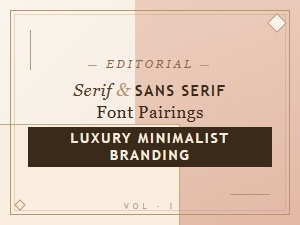 Serif and Sans Serif Pairings for Luxury Minimalist Brands
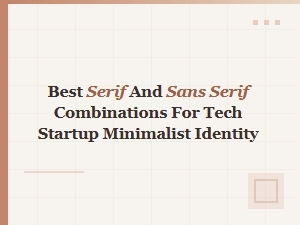 Best Serif and Sans Serif Combos for Tech Startups
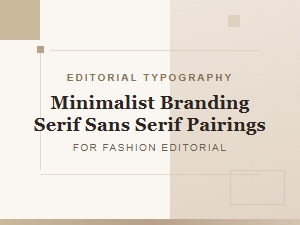 Minimalist Fashion Editorial: Serif + Sans Serif Pairings
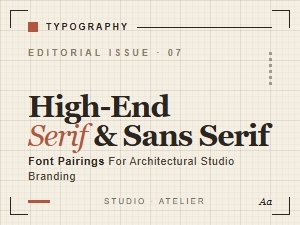 Elegant Serif and Sans Serif Font Pairings for Architectural Studios
 Minimalist Branding with Geometric Font Harmony
 High-Contrast Monospace Pairings for Scandinavian Branding