Finding the right balance for handwritten simplicity font pairing examples for luxury brands comes down to one rule: contrast. A delicate, unembellished script needs a grounded, structured counterpart to feel premium rather than casual. Pairing a minimalist handwritten typeface with a sharp, high-contrast serif or a clean geometric sans-serif creates the refined tension that high-end labels require.
What makes a handwritten font feel luxurious?
Handwritten simplicity strips away the heavy swashes and chaotic loops of traditional calligraphy. It focuses on clean, bespoke lettering that mimics a founder's signature or an artisan's personal note. You use this approach when your brand needs to feel intimate and exclusive, like a niche perfume house, a bespoke tailor, or an organic skincare line.
The goal is to add a human touch without sacrificing elegance. High-end consumers expect refinement. When building a minimalist identity using script typography, the handwritten element acts as a quiet accent, guiding the eye rather than shouting for attention.
How to adjust the pairing for your specific brand
Just as a stylist considers face shape and hair texture, a typographer must look at brand texture and layout constraints. If your brand has a heavy visual texture think dark packaging and bold photography use a very thin, airy handwritten font to prevent the design from feeling cluttered.
Consider the application context. For physical product labels where space is tight, pair your script with a highly legible, condensed sans-serif. If you are designing for digital editorials, you have room to let the handwritten elements breathe alongside a classic transitional serif. Exploring font pairings for a minimalist brand identity helps you match the type to the physical or digital medium.
Common mistakes and how to fix them
The biggest error in luxury typography is using a handwritten font for body text or long paragraphs. Script fonts are strictly for headlines, logos, or short quotes. If your packaging requires detailed ingredient lists or legal copy, switch to a clean, neutral sans-serif to maintain absolute readability.
Another issue is poor kerning and forced connections. Automated spacing often ruins the flow of semi-connected letters. Always adjust the tracking manually so the characters sit naturally. Reviewing specific luxury brand pairing examples will show you how high-end designers manually refine these gaps to create a custom, intentional look.
Final pairing checklist
Before finalizing your typography system, run through these quick checks to ensure your fonts align with a premium aesthetic.
- Verify the handwritten font is only used for short, impactful text under ten words.
- Ensure the secondary font handles all body copy, fine print, and navigation menus.
- Check the contrast in stroke weight between the two chosen fonts.
- Test the pairing on both a large digital screen and a small printed label.
- Manually adjust the kerning on the handwritten logo or headline to fix awkward gaps.
 Handwritten Font Pairings for Minimalist Brand Identity
 Minimalist Branding with Handwritten Script Fonts
 Minimalist Branding with Geometric Font Harmony
 High-Contrast Monospace Pairings for Scandinavian Branding
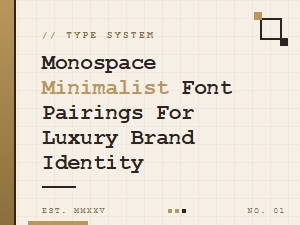 Monospace Minimalist Font Pairings for Luxury Brands
 Geometric Harmony in Luxury Brand Typography